
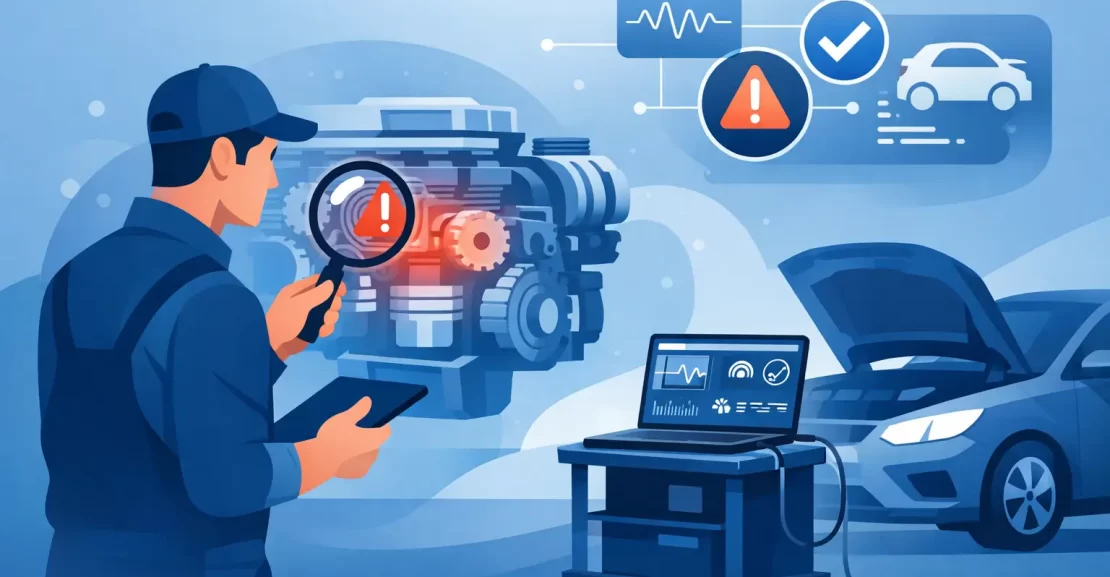
A warning light on the dash is not a diagnosis. Neither is a fault code, a noisy idle or the fact that a car has started using more fuel than usual. Proper engine diagnostics is the process of finding the reason behind the symptom before replacing parts. For older Japanese imports, modified performance cars and European vehicles, that distinction can save a great deal of time, money and frustration.
A 1990s Skyline with an intermittent misfire, a turbocharged Subaru losing boost, or a European sports car dropping into reduced-power mode can each present a simple-looking fault. The underlying cause may be a sensor, wiring issue, vacuum leak, fuel supply problem, worn ignition component or a mechanical concern. Guessing is expensive. Testing is how the real fault is found.
What Engine Diagnostics Actually Involves
Modern vehicles constantly monitor their own systems. When the ECU sees a reading outside its expected range, it may store a diagnostic trouble code and turn on the check-engine light. Reading that code is a useful starting point, but it does not automatically identify the failed component.
For example, an oxygen sensor code may mean the sensor itself has failed. It can also be triggered by an intake leak, exhaust leak, fuel pressure issue, damaged wiring or an engine that is misfiring. Replacing the sensor without checking the surrounding system may clear the light briefly, but it will not fix the cause.
A proper diagnostic process combines scan-tool information with mechanical inspection and targeted testing. That can include checking live sensor data, fuel trims, ignition performance, boost pressure, vacuum readings, compression, charging voltage and wiring continuity. The right test depends on the vehicle, the fault history and the symptoms being reported.
This matters particularly with imported and enthusiast vehicles. Many have had modifications, previous repairs, engine conversions or aftermarket electronics fitted over the years. A car may not behave exactly like a standard local-delivery model, so the diagnosis needs to account for what is actually fitted to the vehicle.
Signs Your Car Needs Engine Diagnostics
The check-engine light is the obvious one, but it is not the only reason to book a diagnostic inspection. A light that comes and goes is still worth investigating, especially if it returns after being cleared. Stored codes and freeze-frame data can provide valuable clues while the fault is present.
Other signs include rough idle, hard starting, misfiring under load, flat acceleration, excessive fuel use, smoke from the exhaust, overheating, unusual engine noise or a noticeable loss of boost. Some faults only appear when the engine is cold, when it reaches operating temperature, under heavy throttle or after a long drive. Giving the workshop clear details about when the issue occurs makes the process more efficient.
Reduced-power or limp-home mode deserves prompt attention. The car is limiting performance because the ECU has detected a condition that could affect reliability, emissions or engine safety. In a turbo vehicle, continuing to drive hard while boost control, fuelling or ignition is not behaving correctly can turn a manageable repair into a larger one.
A flashing check-engine light is more urgent than a steady one. It commonly indicates an active misfire severe enough to damage the catalytic converter. Back off, avoid unnecessary driving and arrange an inspection rather than trying to drive through it.
What to Tell the Workshop
Useful information often shortens diagnostic time. Mention whether the car was hot or cold, whether the problem happened at idle or under load, how long it has been occurring and whether any work was recently completed. If the vehicle has an aftermarket ECU, turbo upgrade, injectors, exhaust, intake, boost controller or alarm system, say so upfront.
It is also helpful to describe the fault rather than diagnose it yourself. “The engine hesitates at 3,500 rpm in third gear” is more useful than “I think it needs coils”. The workshop can then test the likely systems without being directed towards an unproven part.
Why Fault Codes Do Not Tell the Whole Story
Fault codes identify a circuit or operating condition that the ECU believes is outside normal limits. They are not a parts-shopping list. A code for a cylinder misfire, for instance, could lead to spark plugs, coil packs, injectors, compression, air leaks or even ECU and wiring checks.
Live data helps put that code into context. Fuel trims can show whether the engine is adding or removing fuel to compensate for a mixture issue. Airflow readings can reveal a problem with a mass air flow sensor or intake path. Coolant temperature data may expose a sensor that is giving the ECU the wrong warm-up information. On turbo cars, requested versus actual boost figures can help narrow down control, leak or mechanical issues.
However, scan data is only one part of the job. Older JDM vehicles can have ageing connectors, brittle vacuum hoses, corroded earth points and previous wiring repairs hidden behind trim or under the bonnet. A visual inspection and hands-on electrical testing are often just as valuable as the scanner.
The same principle applies to European vehicles. Their systems can be highly integrated, meaning one voltage, communication or sensor issue may trigger several warnings at once. The first code displayed is not always the first fault that occurred.
A Sensible Diagnostic Process
Good diagnostics follows a sequence instead of jumping straight to replacement parts. The vehicle’s complaint and service history are considered first, followed by a scan for current, pending and stored faults. The technician then checks whether the symptom can be reproduced and whether the available data supports the likely cause.
From there, testing becomes specific. An ignition misfire may require plug, coil, injector and compression checks. A lean-running fault may call for smoke testing the intake, checking fuel pressure and assessing sensor readings. A charging warning can involve battery condition, alternator output, belt condition, earth connections and voltage drop tests.
This approach takes longer than plugging in a code reader and naming a component, but it is the correct trade-off. Diagnostics has a cost because it involves skilled labour and equipment. It can still be far cheaper than replacing several good parts in the hope that one of them fixes the problem.
There are occasions where a known weak component is a reasonable first repair, particularly when the evidence is clear and the part is due for replacement anyway. Even then, the repair should be verified afterwards. Clearing a code is not proof that the problem is solved.
Common Issues on Older Imports and Performance Cars
Age and heat are hard on every vehicle, regardless of kilometres. On 1990s and 2000s Japanese classics, rubber hoses, ignition components, sensors and electrical connectors may be well beyond their original service life. Cars that have spent years being driven lightly can still develop faults once they return to regular road use.
Modified cars add another layer. A larger turbo, freer-flowing exhaust or aftermarket intake may be perfectly suitable when the tune, fuelling and supporting hardware are correct. But a boost leak, tired fuel pump, incorrect sensor scaling or poor wiring connection can make the car drive badly or run outside safe limits. Diagnosing these vehicles means checking the complete setup, not blaming the newest part fitted.
Imported cars can also have different ECU calibrations, connectors and parts specifications from Australian-delivered equivalents. Correct part identification matters. Fitting a visually similar but incorrect sensor or ignition component can create a new fault that is difficult to trace.
Protect the Engine While the Fault Is Being Found
If the vehicle is overheating, knocking, producing heavy smoke, losing oil pressure or flashing the check-engine light, do not continue driving it normally. Stopping early can prevent major engine damage. A tow is often a better outcome than an engine rebuild.
For less urgent symptoms, avoid hard acceleration, high boost and long trips until the cause is confirmed. Check basic items such as oil level, coolant level and obvious loose intake piping, but avoid disconnecting sensors or repeatedly clearing codes before inspection. That can erase evidence that helps identify an intermittent fault.
Regular servicing also gives many faults fewer places to hide. Fresh fluids, correct spark plugs, clean filters, sound belts and hoses, and a battery in good condition provide a reliable baseline. For enthusiast cars, especially those that are not driven every day, preventative checks are part of keeping the car performing at its best.
At Sinergy Motorsports, engine diagnostic work is approached with the same practical mindset used for maintaining Japanese classics, performance imports and European vehicles: identify the cause, confirm the repair and use suitable parts where they are required. If your car is showing a warning light or simply does not feel right, booking it in before the symptom worsens gives you the best chance of a straightforward repair.