
A turbo that has lost boost, started whining or sent smoke out the exhaust does not automatically need a new core. Turbo repair starts with finding the actual fault. On a modified Skyline, Supra, EVO, European performance car or daily-driven imported SUV, the symptom can come from the turbocharger itself, but it can also be caused by a boost leak, oil supply issue, faulty actuator or sensor problem.
Replacing parts before confirming the cause is an expensive way to chase power. A proper inspection protects the engine, avoids repeat failures and helps you decide whether repairing, rebuilding or replacing the turbo is the right call.
What are the signs your turbo needs attention?
Loss of power is usually the first sign owners notice. The car may feel flat through the mid-range, take longer to build boost or drop into a reduced-power mode. A sudden change deserves attention, particularly on an older Japanese import where original hoses, vacuum lines and control solenoids may now be decades old.
A high-pitched siren noise that rises with engine speed can point to damaged turbo bearings or compressor wheel contact. Excessive black smoke under boost may indicate an air or fuelling issue, while blue-grey smoke can suggest oil is entering the intake or exhaust side of the turbo. Neither should be ignored.
Other common warning signs include increased oil consumption, oily intercooler pipework, an engine warning light, inconsistent boost pressure and a rattling wastegate. These symptoms overlap with other mechanical faults, so the turbo should not be condemned based on one sign alone.
Accurate turbo diagnosis comes first
The most useful turbo repair is often the one that prevents an unnecessary turbo replacement. Before removing anything, a specialist workshop should look at the full system: intake tract, intercooler piping, exhaust leaks, boost control hardware, oil condition and fault codes where applicable.
A split intercooler hose can make a healthy turbo feel dead. A sticking wastegate actuator may cause underboost or overboost. On electronically controlled vehicles, a failed boost pressure sensor or solenoid can produce symptoms that feel mechanical. For modified cars, an unsuitable tune, incorrect boost target or poorly matched supporting parts can also place the turbo outside its intended operating range.
The turbo itself is then checked for shaft play, damaged compressor or turbine blades, oil contamination and signs of housing contact. Some movement in a journal-bearing turbo when it is dry is normal. What matters is whether the shaft has excessive radial or axial movement, whether the wheels have touched the housings, and whether oil has bypassed the seals.
This diagnosis matters even more when a turbo has failed. Fitting a replacement without addressing the cause can destroy the new unit quickly. Restricted oil feed lines, blocked oil drains, contaminated oil, foreign material in the intake and excessive crankcase pressure are all repeat-failure risks.
Common causes of turbo failure
Turbochargers operate at extreme speed and temperature. They depend on clean oil, correct oil pressure and a clear drain path to survive. Missed servicing or the wrong oil specification can gradually damage bearings and seals, even if the car still feels normal for a time.
Oil starvation is one of the most serious causes. Carbon build-up in an oil feed line, a damaged line, low oil level or a lubrication issue can affect the bearing within seconds. Equally, oil that cannot drain freely from the turbo can back up and force its way past the seals. This is particularly relevant on modified vehicles with aftermarket turbo setups, where oil feed and drain routing must be correct.
Foreign-object damage is another common issue. A damaged air filter, loose intake hardware or debris left in pipework can strike the compressor wheel. On the exhaust side, broken engine components or material from a deteriorating catalytic converter can damage the turbine wheel.
Heat also takes its toll. Repeated hard use followed by immediate shut-down can stress components, especially on older turbocharged cars without effective cooling strategies. Heat alone does not make a turbo fail, but combined with ageing oil, worn lines or high boost, it shortens the margin for error.
Turbo repair, rebuild or replacement?
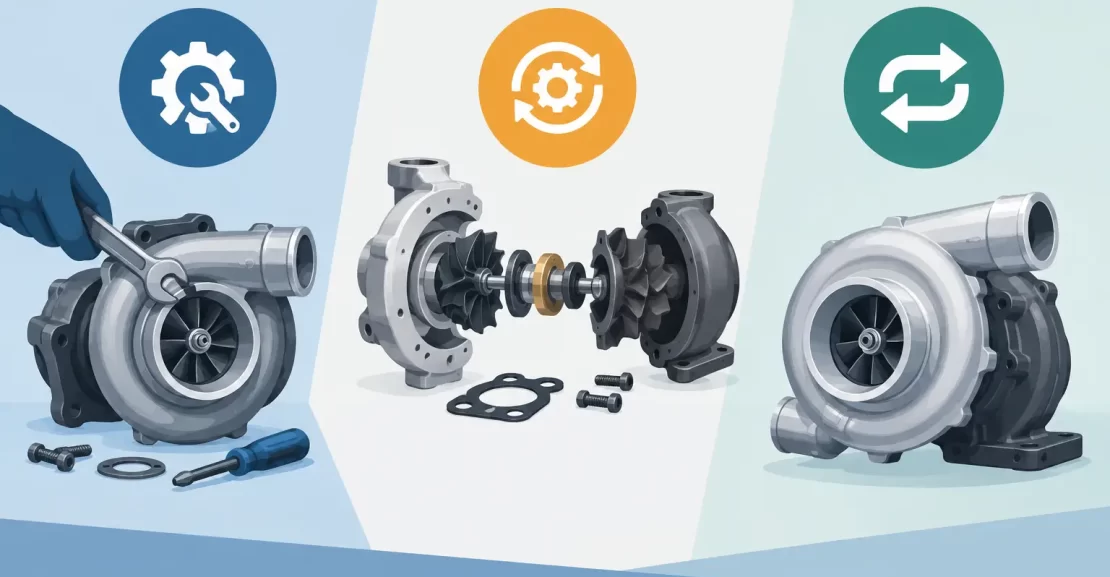
The right option depends on the condition of the unit, parts availability, intended use and budget. A boost leak or actuator fault may be repaired without opening the turbocharger. If the centre housing and rotating assembly are sound, a targeted repair can be the most sensible and cost-effective outcome.
A rebuild may suit a serviceable turbo with worn bearings, seals or a damaged cartridge, provided the housings are usable and quality parts are available. The work needs precise balancing and assembly. A turbo is not a component to rebuild with a generic seal kit on the workbench and hope for the best, particularly where performance, reliability and engine safety matter.
Replacement is usually the better option when the housings are cracked, wheels are badly damaged, the shaft has contacted the housing, or the turbo has suffered major oil starvation. It may also make more sense where a genuine replacement or quality aftermarket unit is readily available at a reasonable cost.
For modified JDM cars, replacement creates another decision: standard-style turbo, upgraded high-flow unit or a larger aftermarket setup. Bigger is not automatically better. A larger turbo can support more top-end power, but may change response, require fuelling upgrades, exhaust work, intercooler capacity and professional tuning. The best setup is the one that suits how the car is driven, whether that is a responsive street GT-R, a weekend track car or a reliable family diesel.
What should be replaced with a failed turbo?
A replacement turbo should never be treated as a bolt-on fix. The oil feed and drain system need inspection and, where required, cleaning or replacement. Fresh oil and filter are essential. Intake piping, intercooler plumbing and exhaust components should be checked for debris and excess oil before the engine is run.
If a turbo has released oil into the intercooler, that oil must be removed. Leaving it in the system risks smoke, poor running and, in some diesel engines, a serious runaway event. The air filter, breather system and crankcase ventilation should also be inspected to rule out a restriction or excessive pressure that may have contributed to the failure.
On many vehicles, it is also sensible to assess related components such as vacuum hoses, boost control solenoids, wastegate actuators and gaskets while access is available. This is not about adding unnecessary work. It is about avoiding the labour cost of pulling the same area apart again for an ageing part that was already showing its limits.
Protecting a repaired or replacement turbo
Regular oil servicing with the correct grade and specification is the foundation. Turbocharged engines are less forgiving of extended oil intervals, especially on older performance imports, cars used for short trips or vehicles that see spirited driving. Check the oil level regularly and investigate unexplained consumption rather than simply topping it up.
Allow the engine to warm through before loading it heavily. That does not mean prolonged idling in the driveway. Drive gently until oil temperature has risen, then use the performance when conditions are right. After a hard run, a short period of calm driving before parking helps reduce heat load through the turbo and exhaust system.
Modified cars need the whole package to be matched. More boost without adequate fuelling, cooling, tuning and maintenance can turn a promising upgrade into a costly repair. The same applies to cheap, unknown turbochargers. Initial savings can disappear quickly if fitment, balancing, durability or boost control is poor.
Specialist support for imported performance cars
Turbo systems on 1990s and 2000s Japanese vehicles often combine ageing factory hardware with years of modifications by previous owners. That makes experience valuable. A workshop familiar with JDM platforms can identify what is original, what has been changed and what is likely to cause trouble next.
At Sinergy Motorsports, the focus is on practical diagnosis and repairs that suit the vehicle and its owner. Whether the job involves tracing a boost leak, assessing a smoking turbo or planning a reliable upgrade, the aim is to keep your car performing at its best without guessing at the fault.
If your car has changed noise, lost boost or begun using oil, book it in before a minor issue becomes a damaged engine or a failed turbo at the worst possible time.