
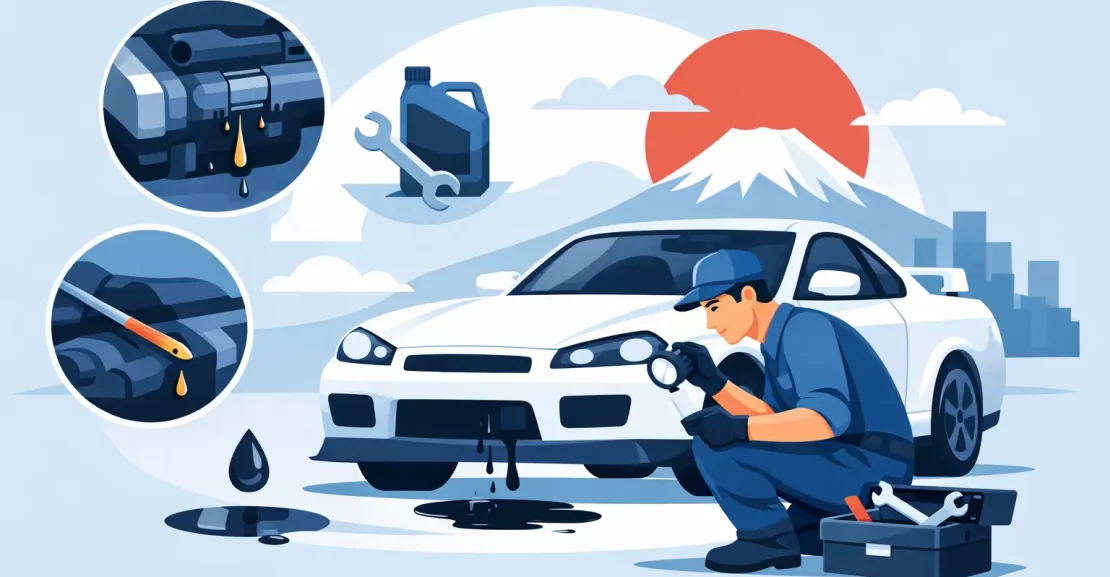
A few drops on the driveway can be easy to dismiss, particularly on a 1990s or 2000s import. But when you diagnose Japanese oil leaks properly, you can separate a minor seep from a fault that threatens belts, bushings, turbo hardware or the engine itself. The visible oil is not always the source. Airflow under the car, old undertrays and oil collecting around the gearbox can all send the diagnosis in the wrong direction.
For JDM classics and performance cars, the right repair starts with finding the first point of escape, not replacing every gasket in sight. That protects the car, controls labour costs and helps keep it performing at its best.
Start by confirming it is engine oil
Before looking for a failed seal, establish which fluid is actually leaking. Fresh engine oil is usually amber to dark brown or black, depending on its age. It has a familiar oily smell and will leave a slick mark between your fingers. Gearbox and differential oils are generally thicker and can have a strong sulphur smell. Automatic transmission fluid is often red or reddish-brown, while power steering fluid may look similar to ATF on many Japanese vehicles.
Coolant can also mix with road grime and look darker than expected. Brake fluid is thinner and should never be treated as a wait-and-see issue. If fluid level is dropping, braking feel changes, or there is a puddle near a wheel or brake line, do not drive the vehicle until it has been inspected.
Check the engine oil level on level ground with the engine off and after allowing the oil to settle. An engine that is low on oil, showing an oil-pressure warning light or making new mechanical noise needs immediate attention. A leak may be modest externally while its effect on oil level is not.
Clean the area before chasing the leak
Old oil makes diagnosis difficult. A rocker cover leak from years ago may have coated the block, transmission bellhousing and front crossmember, even if the current leak is elsewhere. Spraying more cleaner over a dirty engine and making a guess is rarely enough.
The practical approach is to degrease the affected area, dry it thoroughly, then inspect it after a short drive or heat cycle. Start high and work down. Oil always travels downward, so the highest fresh wet point is usually more useful than the lowest drip. A workshop hoist makes this much easier, particularly where the sump, transfer case, turbo oil lines and underbody shielding are involved.
For a leak that only appears after a longer drive, ultraviolet dye can be useful. The dye is added in the correct quantity, the vehicle is run, and a UV lamp reveals fresh oil paths. It is a diagnostic aid, not a substitute for checking crankcase pressure, oil levels and the condition of surrounding components.
Common places Japanese engines leak oil
Rocker cover gaskets and spark plug tube seals
Rocker cover gaskets are common on ageing Nissan, Toyota, Honda, Mazda and Mitsubishi engines. Heat cycles harden the rubber gasket until oil begins to seep along the cover edge. On engines with spark plug tube seals, oil can also collect in the plug wells. That may cause misfires, damage coil boots and make what began as a simple gasket job more expensive.
Do not assume a new gasket alone is the whole answer. Warped covers, stripped threads, incorrect sealant use and blocked PCV systems can bring the leak back. Covers need correct cleaning, proper torque and attention to the manufacturer’s sealant points, usually around cam cap corners or timing cover joints.
Front engine seals and timing cover leaks
Oil around the harmonic balancer, lower timing cover or front of the sump can point to a crankshaft seal, camshaft seal, timing cover sealant failure or an oil pump-related leak. On timing-belt engines, this matters because oil contamination can shorten belt life and affect idlers or tensioners.
The trade-off is labour. Accessing a front seal may involve removing belts, pulleys and timing components. If a timing belt service is due soon, it can be sensible to address related seals at the same time. If the belt was recently replaced and the leak is only a light seep, the repair decision depends on its exact source and whether oil is reaching the belt area.
Sump, drain plug and oil filter housing
A leaking sump can be caused by a flattened gasket, failed RTV sealant, impact damage or corrosion. On lowered imports, the sump deserves a careful check after contact with a steep driveway, speed hump or road debris. A damaged drain plug washer or overtightened plug can also mimic a sump gasket issue.
Oil filter housings, cooler lines and sandwich plates are another common source on modified vehicles. Aftermarket oil coolers and remote filter setups need quality fittings, correct hose routing and regular inspection. A weep from a fitting can become a substantial leak when oil pressure rises under load.
Rear main seal, gearbox area and clutch contamination
Oil dripping from the bellhousing area is often labelled a rear main seal leak. Sometimes that is correct, but oil from higher up can run down the back of the block and exit through the same area. A rocker cover, PCV hose, oil pressure switch or turbo drain above the gearbox may be responsible.
Confirming the source matters because a rear main seal repair generally requires gearbox removal. On a manual car, it is worth assessing clutch condition while access is available. If oil has contaminated the clutch disc, replacing only the seal may not solve shudder or slipping.
Turbocharger feed and drain lines
Turbocharged Japanese cars add several oil leak points. The turbo oil feed line, banjo bolt sealing washers, drain gasket and drain hose should all be checked. Heat from the turbine housing can harden hoses and cook residue onto fittings, hiding the origin of the leak.
A turbo oil leak is not automatically a failed turbocharger. Excessive crankcase pressure, restricted oil drains or poor line installation can force oil past otherwise serviceable seals. Smoke, loss of boost, unusual turbo noise and a rising oil consumption rate warrant a more thorough inspection.
Crankcase ventilation can be the underlying fault
If an engine is pushing oil out through multiple seals, do not keep replacing gaskets without checking the PCV system. A blocked PCV valve, collapsed breather hose or poorly designed catch-can setup can allow crankcase pressure to build. That pressure looks for the weakest seal.
This is particularly relevant on modified turbo cars, where boost, blow-by and aftermarket intake plumbing can change how the ventilation system behaves. A catch can is not automatically an improvement if it is undersized, incorrectly plumbed or left unserviced. The system needs to vent and separate oil vapour as intended without introducing unmetered air or pressure problems.
When a small leak can wait, and when it cannot
A light rocker cover seep that leaves no drips, does not lower the oil level and is well away from hot exhaust components may be monitored between services. Record the oil level, clean the area and check it again after a few drives. This is often a reasonable short-term approach for a classic being planned for broader restoration work.
It should not wait if oil is reaching an exhaust manifold or turbo, dripping onto the road, contaminating a timing belt, soaking engine mounts, entering spark plug wells, affecting the clutch, or requiring frequent top-ups. Burning oil smells and smoke from the engine bay also deserve prompt inspection. Apart from the fire risk, oil on rubber components shortens their service life.
Avoid relying on stop-leak additives as a first response. They can temporarily swell seals, but they do not repair a damaged gasket, warped cover, cracked hose or blocked breather system. On an older import with unknown service history, they can complicate diagnosis.
Use parts that suit the job
Not every oil leak needs genuine parts, but not every cheap gasket is a saving. Quality OEM or proven aftermarket seals are generally the right choice for high-heat and difficult-access areas. The labour to reach a rear main seal, timing cover or turbo drain is often worth more than the difference between a questionable gasket and a reliable one.
A specialist inspection is particularly valuable when the car has modifications, an engine conversion, limited local parts information or previous repair work of uncertain quality. At Sinergy Motorsports, experience with Japanese imports means the fault can be traced before repairs are recommended, with the right parts selected for the vehicle rather than a one-size-fits-all fix.
If you have found fresh oil, take a photo of the location, check the dipstick and arrange an inspection before the residue spreads. Catching a leak while it is still a clean, contained repair is usually the best way to protect a well-kept import.