
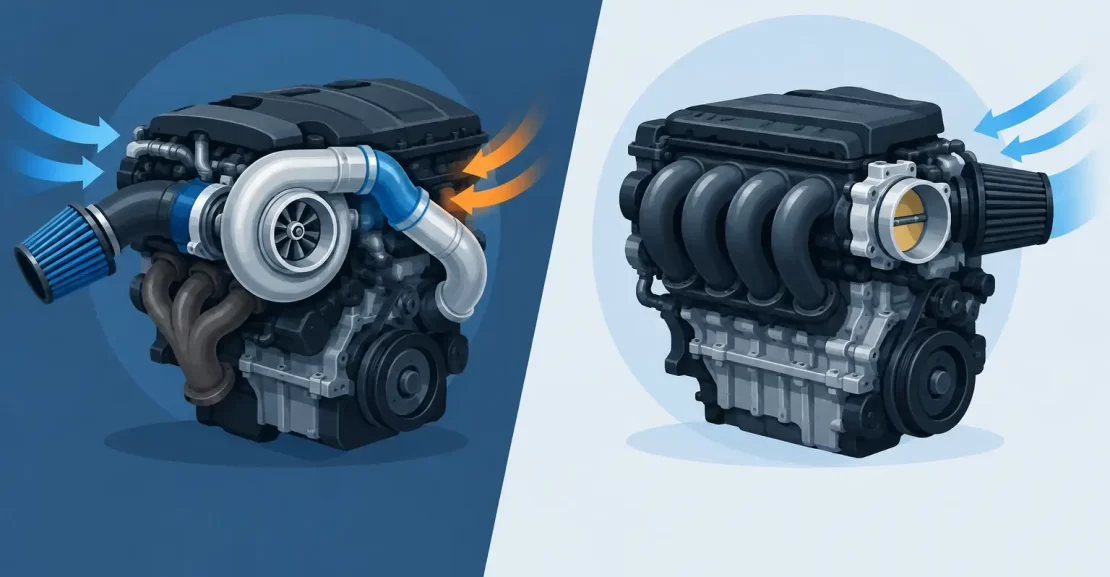
A clean S2000 at full revs, an R34 Skyline coming on boost, or a naturally aspirated V8 European coupe all make their point in very different ways. The turbo versus naturally aspirated engines debate is not simply about which makes more power. It is about how a car responds, how it delivers its performance, what it costs to maintain, and whether it suits the way you actually drive.
For buyers considering a JDM classic, a newer performance import or a European sports car, the right answer depends on the specific engine, its condition and your plans for the car. A well-sorted naturally aspirated engine can be every bit as rewarding as a boosted one. Equally, a factory turbo car can offer usable performance that a larger-capacity naturally aspirated engine cannot match.
How each engine makes power
A naturally aspirated engine draws air into its cylinders through atmospheric pressure. There is no forced induction system compressing the intake charge before it enters the engine. More air and fuel can still be moved through the engine by increasing capacity, engine speed, compression, valve lift and intake efficiency, but power is closely tied to revs and displacement.
A turbocharged engine uses exhaust gas to spin a turbine. That turbine drives a compressor, which forces more air into the engine. With more air available, the engine can burn more fuel and make considerably more torque and power from a relatively small capacity.
That basic difference explains why a 2.0-litre turbo four can produce the sort of mid-range pull once expected from a much larger six-cylinder engine. It also explains why many naturally aspirated classics need revs to feel alive, while a turbo car can feel fast well before the tacho reaches the redline.
Turbo versus naturally aspirated engines on the road
Response and power delivery
Naturally aspirated engines are valued for direct throttle response. Press the accelerator and the engine reacts without waiting for a turbocharger to build speed and boost pressure. In a light, high-revving car such as a Honda Integra Type R or S2000, that linear response is a major part of the experience. The driver is encouraged to work through the rev range, choose the right gear and keep the engine in its power band.
Turbo engines generally deliver more torque lower in the rev range. A turbocharged Skyline, Supra, Evolution or WRX can feel effortless in normal traffic because it does not need to be revved as hard to accelerate strongly. Modern turbo systems have reduced lag dramatically, but older Japanese performance cars can still have a noticeable change in character as boost arrives.
Neither approach is automatically better. Some owners enjoy the build-up and surge of an older turbo engine. Others prefer the precise, predictable response of a naturally aspirated engine, especially on a winding Adelaide Hills road or during a track day where smooth throttle control matters.
Peak power and modification potential
Turbocharged engines usually offer more straightforward power gains. Raising boost pressure, improving intercooling, fitting a freer-flowing exhaust and recalibrating the ECU can produce meaningful results when the engine, fuel system and drivetrain are prepared properly. This is why platforms such as the RB, JZ, SR and 4G63 remain popular with enthusiasts.
The important word is properly. More boost creates more cylinder pressure and heat. A modification package needs to account for fuel quality, injectors, pump capacity, airflow metering, ignition timing, cooling and the condition of the engine itself. Chasing a headline number without addressing those supporting systems is an expensive way to find the weak point.
Naturally aspirated engines can also be modified, but the gains are often smaller for the money spent. Extractors, exhausts, intake work, camshafts, head work and tuning can sharpen a car considerably, yet significant power increases may require internal engine work or more capacity. The reward is often response, sound and a stronger top end rather than a dramatic torque increase.
Heat, servicing and long-term ownership
A turbocharger operates in a very hot environment. It relies on clean oil, correct oil pressure and, on many applications, an effective cooling system. Neglected oil changes, blocked oil feeds, tired cooling components and poor tuning can shorten turbo life quickly. On older imports, cracked vacuum lines, brittle intercooler hoses and ageing sensors can also cause boost leaks or inconsistent running.
This does not make turbo cars unreliable by default. Factory turbo cars that are serviced on schedule, warmed through before hard use and allowed sensible cool-down time can cover serious kilometres. The key is buying on condition rather than assuming every turbocharged car has been driven hard or modified correctly.
Naturally aspirated engines have fewer forced-induction components, so there is less hardware to inspect and repair. That can make them simpler to own, particularly in older cars. But simplicity is not the same as immunity from expensive faults. High-revving naturally aspirated engines still depend on good oil, cooling-system health, correct valve clearances where applicable, and regular timing belt or timing-chain checks.
For either type, service history matters more than odometer reading alone. A documented car with regular fluid changes, quality parts and evidence of careful repairs is generally a safer proposition than a lower-kilometre example with unknown history.
Fuel use is not as simple as engine size
Small turbo engines are often marketed as efficient because they can cruise with light throttle and make strong torque without large capacity. In real-world driving, economy depends heavily on boost use. Drive gently and a turbo engine may return respectable figures. Use its performance regularly and it will consume fuel accordingly.
A naturally aspirated engine can be predictable in this respect. It may use more fuel around town if it has a larger capacity, but it does not need extra fuel enrichment under boost. A six-cylinder Toyota, Nissan or BMW can be a relaxed long-distance car, even if it will not match the theoretical efficiency figures of a smaller modern turbo engine.
Australian fuel quality also needs consideration with performance imports. Higher-compression naturally aspirated engines and turbo engines with aggressive tuning may require premium unleaded. A proper tune for the fuel you will actually use is far more valuable than an optimistic imported tune designed for different conditions.
Which setup suits your driving?
Choose naturally aspirated if you value immediate response, linear power and a mechanical connection to the engine. It is a particularly strong choice for drivers who enjoy manual gear changes, high-revving engines and weekend road driving. Cars such as naturally aspirated Hondas, rotary Mazdas in good condition, Toyota 86s and selected European sports cars can make modest power feel genuinely engaging.
Choose turbocharged if you want strong mid-range torque, easier power gains or effortless acceleration in a heavier car. Turbo power suits street driving, overtaking, highway use and performance builds where the supporting maintenance and tuning budget is realistic. It can also be the right choice for a practical family vehicle, SUV or van where low-down torque makes daily driving easier.
There is also a middle ground. Some buyers want a stock or lightly modified factory turbo car because it offers the character they enjoy without chasing big numbers. Others prefer a naturally aspirated classic specifically because it has not been altered, boosted or pushed beyond its original design.
What to inspect before buying an older performance import
On a turbo car, look for oil smoke, inconsistent boost, unusual turbo noise, poor idle quality, overheating, leaking intercooler piping and signs of rushed modifications. Ask who tuned it, what fuel it was tuned for, and whether there are records for the timing belt, water pump, cooling system and turbo work.
On a naturally aspirated car, check for oil consumption, cooling issues, rough idle, timing-system noise and evidence that it has been regularly serviced. A compression test or leak-down test can be worthwhile on higher-value classics, particularly where engine rebuilding costs are substantial.
A pre-purchase inspection from a workshop familiar with the platform is money well spent. Sinergy Motorsports has more than 20 years of experience with Japanese classics and can help identify the condition issues that a standard inspection may overlook.
The best engine is the one that matches your expectations and has been cared for properly. Test drive the car, inspect its history, be realistic about maintenance, and buy the example that makes you want to take the long way home.