
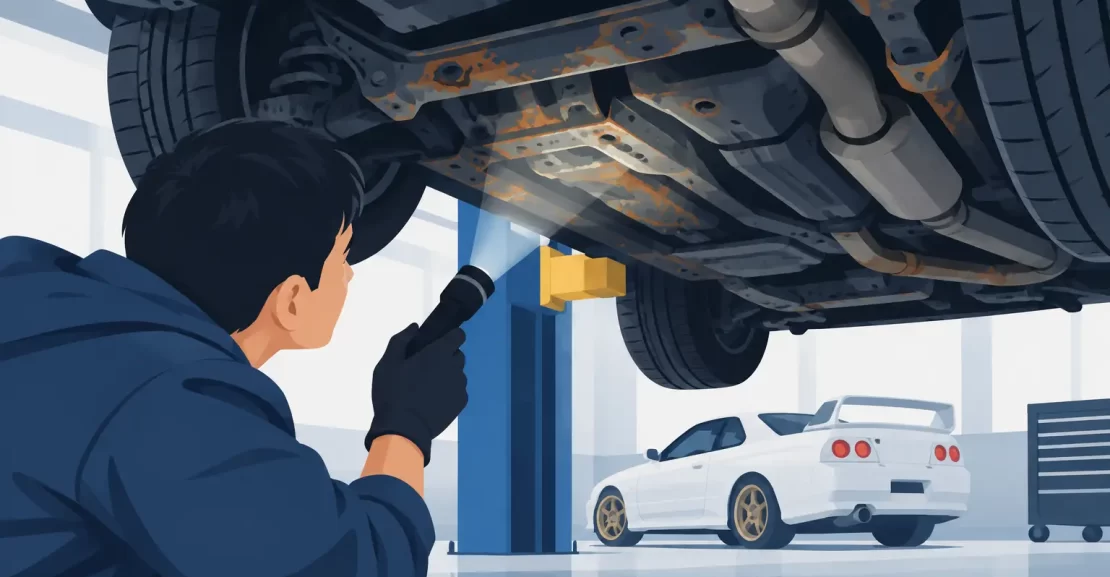
A clean engine bay, fresh tyres and a tidy interior can make an imported Skyline, Supra or Honda look like an easy buy. The real condition check is underneath. Knowing how to inspect JDM underbody rust can save you from buying a car that looks exceptional on the showroom floor but needs major structural work before it is safe, compliant or worth restoring.
Rust is not an automatic reason to walk away from every Japanese import. Many 1990s and 2000s classics have light corrosion that can be cleaned, treated and protected. The difference is where it sits, how far it has spread and whether it has already compromised the body, suspension mounting points or safety systems.
Why JDM imports can rust underneath
Japan’s climate varies dramatically. Cars from snowy regions can be exposed to road salt, while coastal areas bring humid air and salt spray. A vehicle may have relatively low kilometres and still carry corrosion from years spent in Hokkaido, Niigata or another snow-prone area. Storage matters as much as location. A car parked outdoors on damp ground, then shipped and left sitting for long periods, can deteriorate quickly.
Australian conditions add another factor. An import may arrive with existing corrosion hidden beneath underseal, then collect dust, moisture and road grime after local use. Water trapped behind wheel-arch liners, inside chassis rails or around rubber plugs can keep working away long after the car has left Japan.
The good news is that a proper inspection reveals far more than a few surface marks. Do not judge an underbody from auction photos or a quick look with the car parked on the ground.
Inspect JDM underbody rust with the car on a hoist
A hoist is the right place to assess any older import. It gives you clear access to the floorpan, rails, subframes, suspension arms, exhaust, fuel lines and the areas a seller may not show in photos. A workshop inspection before purchase is money well spent, particularly when the car is a performance model or a rare example where parts and body repairs can be expensive.
Start with the overall picture. Light orange staining on bolts, brackets and exhaust components is common. It is usually surface corrosion and not necessarily a concern. What matters is flaky metal, deep pitting, swelling seams, holes, fresh black coating over rough areas, or rust growing from behind seam sealer.
Use a bright torch and look for consistency. An honest, original underbody may show age across several components. A suspicious car can have one unusually fresh section of underseal or paint, especially around the rails, sills or rear floor. Fresh coating is not proof of a poor repair, but it should prompt closer inspection. A competent repair should have sound metal beneath it, clean welds, sealed joins and corrosion protection applied properly.
The areas that deserve the closest look
Chassis rails and floorpan
Chassis rails are high on the priority list. Check the full length of each rail, not just the visible outer face. Look around drain points, jacking locations and where the rail meets the floor. If a rail has been crushed by incorrect jacking, it can trap water and begin rusting from inside.
The floorpan can collect damage from poor lifting, road debris and previous repairs. Pressed metal should feel solid when carefully tested by a professional. Rust that has thinned the floor, lifted seam sealer or created soft sections is a different proposition from superficial discolouration.
Sills, wheel arches and inner guards
Sills often rust from the inside out. Check the pinch welds, drain holes, ends of the sill near each wheel arch and the lower area behind plastic trims. Bubbling paint or thick sealant at the outer sill can indicate corrosion that extends well beyond what you can see.
Front and rear wheel arches also deserve close attention, particularly where inner and outer panels meet. On models such as Skylines, Silvias and older Hondas, inspect the rear arch lip, rear quarter lower sections and the area behind the front guards. Mud, leaves and moisture can sit in these pockets for years.
Suspension mounting points and subframes
Surface rust on a removable subframe or control arm is often repairable, provided the component is structurally sound and replacement parts are available. Rust around the mounting points is more serious. Check where the front crossmember, rear subframe, trailing arms, shock absorbers and sway bars attach to the body.
These areas carry load. Heavy corrosion, cracked seams or metal separating around a mount can turn a straightforward tidy-up into major fabrication work. It also affects alignment, handling and roadworthiness.
Fuel, brake and cooling lines
Do not overlook the smaller components. Steel brake lines, fuel lines and their retaining clips can corrode in places that are difficult to see. A rusty line may appear acceptable until it is moved or pressurised. Check hard lines along the floorpan and above the rear subframe, as well as the condition of rubber hoses and line brackets.
Cooling pipes beneath the car, where fitted, need the same attention. On some Japanese vehicles, a corroded pipe can create an inconvenient leak. Brake line failure is obviously a much more serious risk.
Boot floor, spare-wheel well and rear chassis sections
Lift the boot carpet and inspect the spare-wheel well from above. Water leaks through tail-light seals, boot seals or body seams often show up here first. From underneath, inspect the rear floor, tow points and chassis sections behind the rear wheels.
A clean boot interior does not guarantee a clean underside, but damp carpet, staining, mould smell or fresh paint around the spare wheel area should be investigated. These signs may point to a leak, accident repair or previous corrosion treatment.
Telling surface rust from a costly problem
Surface corrosion is usually limited to the outer layer of metal. It may look untidy, but a wire brush, rust treatment, primer and suitable protective coating can stop it progressing. Exhaust heat shields, fasteners, some suspension arms and brackets commonly fall into this category.
Structural rust has penetrated deeper. You may see flaking layers, pinholes, sharp edges, deformed metal, swelling around seams or patches covering a larger problem. If a screwdriver or inspection pick easily breaks through metal, the repair is no longer cosmetic. Avoid aggressive probing yourself, as you can damage protective coatings or weakened areas. A specialist can test suspect sections properly and explain what is repairable.
Repair cost depends on access, not just the size of the rusty spot. A small hole in an easily reached boot floor can be straightforward. Corrosion inside a sill, around a suspension mount or within a boxed chassis rail can require trim removal, cutting, fabrication, welding, sealing and repainting. On a valuable or hard-to-find JDM car, the work may still make sense. On an average example, it can quickly exceed the car’s value.
Check the history, not just the metal
Auction sheets, Japanese service records, import approval paperwork and Australian inspection history all add useful context. They cannot replace a physical inspection, but they can help explain what you are seeing. A car from a snow region with documented underbody treatment may be a better prospect than one with no history and freshly applied underseal.
Ask whether the car has had rust repairs, chassis repairs or an underbody restoration. A straight answer with photographs and invoices is encouraging. Vague claims that it is “just surface rust” are not enough when the affected area cannot be clearly shown.
If you are buying from interstate, request detailed underside photos before committing to travel or transport. Ask for clear images of the rails, sills, wheel arches, suspension mounts, floorpan and boot floor. Even then, arrange an independent inspection before finalising the purchase where possible.
When to walk away, negotiate or proceed
Walk away when corrosion affects structural rails, suspension mounting points, brake lines or multiple concealed areas, especially if there is no repair history and the seller will not allow an inspection. A cheap purchase price rarely stays cheap once fabrication begins.
Negotiation may be reasonable when the rust is localised, clearly visible and supported by a realistic repair quote. Factor in the work properly, including stripping, refitting, alignment and corrosion prevention afterwards. Do not price the repair as though it is only a quick weld.
Proceed with confidence when the underbody is dry, solid and consistent with the car’s age, or when prior work is documented and professionally finished. A well-maintained Japanese import can provide years of enjoyable driving, but it needs the same level of scrutiny you would give its engine, gearbox and compliance paperwork.
For Adelaide buyers considering an older import, a pre-purchase hoist inspection with a JDM specialist is the sensible next step. Sinergy Motorsports has more than 20 years of experience with Japanese classics and can assess condition before a minor rust concern becomes an expensive ownership problem.