
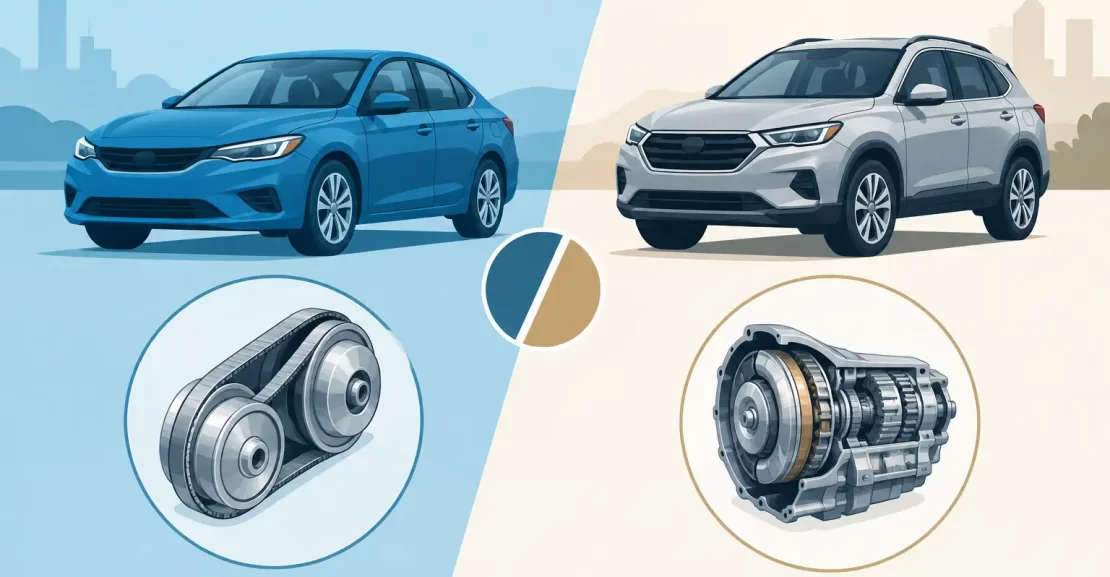
A Japanese import can look perfect on paper – low kilometres, excellent condition and equipment Australian-delivered cars never received. But the transmission deserves just as much attention as the engine. When weighing up CVT versus automatic imports, the right choice comes down to how you drive, the model you are considering and whether its service history supports the kilometres shown.
Neither transmission is automatically the safer purchase. A well-maintained CVT can be an excellent daily driver, while a neglected conventional automatic can become an expensive problem. The key is understanding what is fitted to the vehicle and inspecting it properly before you commit.
CVT versus automatic imports: the real difference
A conventional automatic transmission uses fixed gears, usually with a torque converter. As the car accelerates, you feel distinct shifts between gears. This is the familiar automatic setup found in a wide range of Japanese cars, from 1990s Toyota sedans and Nissan performance models through to later SUVs and vans.
A continuously variable transmission, or CVT, does not work through a fixed set of gear ratios in the same way. It uses variable pulleys and a belt or chain arrangement to keep the engine in its effective rev range. Under acceleration, the revs may rise and stay there while road speed builds. Some newer CVTs imitate stepped gear changes electronically, but their basic operation remains different.
For an owner, that difference is most obvious behind the wheel. A conventional automatic generally feels more direct and predictable, particularly when towing, climbing hills or accelerating hard. A CVT is often smoother around town and can return better fuel economy, especially in smaller cars and hybrid models.
Why many import buyers prefer a conventional automatic
There is a reason conventional automatics remain popular among buyers of older Japanese imports. Their driving feel suits the character of many enthusiast cars, and specialist workshops have long experience servicing and rebuilding established automatic designs.
A torque-converter auto can also be a better match for vehicles that see hard use. Larger engines, turbocharged applications, heavier vans and SUVs, or cars regularly driven through Adelaide Hills roads can place sustained heat and load into a transmission. The right conventional automatic, maintained with the correct fluid and intervals, is often well suited to that work.
This does not mean every older automatic is trouble-free. Age, heat, contaminated fluid and missed servicing can cause harsh shifts, flare between gears, delayed engagement or shuddering. On a 1990s or 2000s import, parts availability and model-specific knowledge matter as much as the transmission type itself.
For performance-oriented buyers, the choice may already be made by the model. Many desirable JDM cars were fitted with conventional automatics, while others are manual-only in the variants enthusiasts seek. If you are purchasing a Skyline, Supra, Chaser, Aristo or similar classic, condition and correct maintenance should carry more weight than a blanket preference for one gearbox design.
When a CVT makes more sense
CVTs are common in later Japanese domestic market hatchbacks, people movers, hybrids and compact SUVs. For a buyer who wants a practical import for commuting, school runs or city driving, a CVT can be a smart option.
The main benefit is efficiency. By keeping engine revs controlled during light throttle driving, a CVT can make good use of a smaller petrol engine or hybrid system. The smooth delivery also works well in traffic. In models such as later Toyota, Honda, Nissan and Subaru imports, the CVT was designed as part of the vehicle package rather than as an afterthought.
The trade-off is driving character. Some drivers dislike the sustained engine note under firm acceleration, often called the rubber-band effect. That is not necessarily a fault. However, excessive flaring, surging, shuddering, vibration or hesitation can point to a transmission issue and should never be dismissed as normal CVT behaviour.
CVTs also reward careful servicing. They do not use a generic automatic transmission fluid, and using the wrong fluid can cause real damage. Correct fluid specification, sensible change intervals and good cooling are particularly important for vehicles operating in Australian heat.
Service history matters more than the badge
The most common mistake is treating an imported vehicle’s low odometer reading as a complete condition report. It is useful information, but it does not tell you whether the transmission fluid has been changed, whether the car sat unused for long periods or whether it has experienced repeated short-trip driving.
Japanese auction documentation and service records can provide valuable background, but they need to be read alongside a physical inspection. A clean auction grade is encouraging. It is not a substitute for checking how the transmission behaves cold and hot.
Ask what work has been completed since importation and whether the transmission has been serviced using the correct manufacturer-approved fluid. On older vehicles, a fluid change may be prudent, but the method matters. A specialist should assess the condition of the existing fluid and the transmission before recommending a flush or service approach.
A vehicle supplied fully roadworthy and serviced removes much of the uncertainty that comes with private importing or buying sight unseen. It also gives you a clear starting point for future maintenance rather than leaving you to guess what has been done.
What to check on a test drive
A proper test drive should include more than a quick lap around the block. Start with the car cold where possible, then drive it long enough for the engine and transmission to reach operating temperature. Some faults only appear once fluid is warm.
Pay close attention to the following signs:
- Delayed engagement when selecting Drive or Reverse, particularly after the vehicle has been parked.
- Harsh, slipping or erratic shifts in a conventional automatic under light and firm throttle.
- A CVT that shudders on take-off, revs excessively without corresponding acceleration, or surges at a steady speed.
- Whining, droning or grinding noises that change with road speed or throttle input.
- Warning lights, transmission messages, leaks beneath the vehicle or a burnt smell after driving.
None of these symptoms automatically confirms a major failure. A weak battery, engine misfire, worn mounts or driveline issue can sometimes feel like a gearbox problem. That is exactly why a pre-purchase inspection by a workshop familiar with Japanese imports is worthwhile.
Reliability depends on the model, not just CVT or auto
Broad claims such as “CVTs are unreliable” or “old automatics last forever” are too simplistic. Reliability varies heavily between manufacturers, generations, engine pairings and maintenance records.
Some early CVT applications developed a poor reputation because of heat management, software calibration or missed servicing. Later units are often significantly improved. Likewise, many traditional automatics are durable, but a neglected unit in a heavy luxury sedan can cost far more to repair than a properly maintained CVT in a small hybrid.
Research the exact chassis code, engine and transmission combination before buying. Japanese imports can have specifications that differ from Australian-delivered versions, even where the model name is the same. That affects fluid requirements, diagnostic procedures and parts sourcing.
For older or unusual vehicles, access to OEM and quality aftermarket components should be considered before purchase. A transmission problem is easier to manage when the correct filters, seals, sensors and service parts can be sourced without extended delays.
Choose for the job the car will actually do
If you want a weekend car, touring vehicle or older performance import, a conventional automatic may offer the engagement, durability and established repair support you prefer. If you need an efficient commuter, hybrid family car or compact people mover, a well-kept CVT may be the more sensible fit.
Do not buy either transmission type purely on reputation. Buy the best example available, with documented servicing, a clean inspection and a test drive that feels right. At Sinergy Motorsports, the focus is on helping owners keep their imported vehicles performing at their best long after the sale – because the right transmission choice is one you can enjoy and maintain with confidence.