
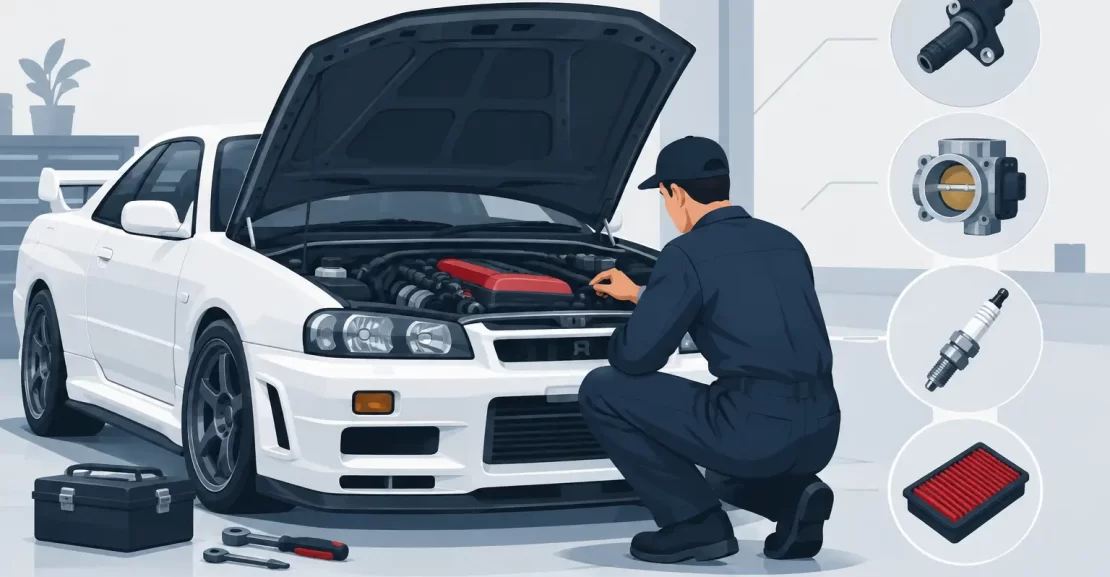
A JDM car that starts cleanly but hunts, stalls at the lights or sits at 1,500 rpm once warm is telling you something. To fix JDM idle problems properly, resist the temptation to replace sensors at random. Older Japanese imports often have a simple fault causing a frustrating symptom, but age, previous modifications and model-specific systems make a methodical diagnosis essential.
A rough idle can feel minor until it affects cold starts, fuel economy, drivability and the life of expensive components. On a 1990s or 2000s Skyline, Silvia, Supra, Evo, RX-7, Honda or Toyota, the correct repair starts by working out whether the engine is receiving the right amount of air, fuel and spark – and whether the ECU has reliable information to control them.
Start by identifying the idle fault
Not every idle issue is the same. A high idle that stays above 1,200 rpm after the engine is fully warm points in a different direction from an engine that drops below 500 rpm and threatens to stall. An idle that surges up and down is also different again.
Pay attention to when the fault occurs. Does it only happen cold, once warm, with the air conditioning on, after a long drive, or when the steering is turned at low speed? Does the engine idle poorly in neutral but drive strongly under load? These details save time and prevent unnecessary parts purchases.
If the check-engine light is on, or the vehicle allows fault-code retrieval, begin there. A stored code is not an automatic diagnosis, particularly on older cars, but it gives the inspection a sensible starting point. Some early JDM vehicles use manufacturer-specific diagnostic connectors and procedures, while later models may use OBD systems. The right scan tool and service information matter.
Check the basics before blaming the ECU
A large number of idle faults come down to basic maintenance or unmetered air. Before adjusting anything, inspect the intake system from the airbox through to the inlet manifold. Look for split rubber intake pipes, loose clamps, perished vacuum hoses, disconnected breather lines and damaged intercooler piping on turbocharged cars.
Vacuum leaks are especially common on ageing imports. Hoses harden with heat, factory rubber elbows crack underneath where they cannot be seen, and aftermarket boost gauges, blow-off valves or catch cans may have introduced extra lines and fittings. Air entering after the airflow meter can produce a high idle, lean running, hesitation or an idle that surges as the ECU tries to correct the mixture.
A smoke test is one of the quickest ways to find leaks that visual checks miss. It is preferable to spraying flammable products around a running engine bay, which is not a safe or reliable diagnostic method.
Also inspect the throttle cable and throttle body. A cable adjusted too tightly can stop the throttle plate from returning completely. Carbon around the throttle plate can restrict its closing position or upset airflow at idle. On drive-by-wire models, the issue may be electronic rather than mechanical, so do not force the throttle plate or alter settings without the correct procedure.
Clean the idle air control system carefully
Many classic JDM engines use an idle air control valve, idle speed control valve or auxiliary air valve to bypass a measured amount of air around the closed throttle plate. When it sticks, becomes carboned up or its passages block, the result can be stalling, low idle, hunting or poor cold idle.
Cleaning the throttle body and idle-control passages can help, but it is not a cure-all. Use a throttle-body-safe cleaner, follow the vehicle-specific procedure and replace gaskets if they are disturbed. Some systems need an idle relearn after cleaning or after the battery has been disconnected. Others have a base idle adjustment that must only be set with the engine warm and the relevant diagnostic mode activated.
This is where many well-meaning repairs go wrong. Turning a base idle screw to mask a vacuum leak or failed idle valve may make the car appear better for a day, but it leaves the ECU operating outside its intended range. The fault usually returns, often with worse cold-start behaviour.
When the idle valve is not the real problem
An idle valve may be doing exactly what the ECU asks. If coolant temperature data is incorrect, for example, the ECU may continue to command extra idle air as though the engine is cold. Likewise, an air conditioning idle-up signal, power-steering pressure switch or electrical-load compensation circuit can hold the revs higher than expected.
Check actual coolant temperature data with a scan tool where possible, rather than relying only on the dash gauge. The gauge can look normal while the ECU temperature sensor is inaccurate. On vehicles with separate gauge and ECU sensors, it is easy to test the wrong one.
Test air, fuel and ignition as a system
Once intake leaks and idle-control hardware have been checked, look at the engine’s core inputs. A dirty or failing airflow meter can cause a lumpy idle, hesitation and rich or lean running. Do not touch the sensing element with a rag or compressed air. If cleaning is appropriate for that meter type, use a dedicated airflow-meter cleaner and allow it to dry fully.
A throttle-position sensor can also cause trouble if the ECU cannot recognise closed throttle. Some older units are adjustable and need to be set to specification. Others are not. Guessing the position can affect idle control, fuel cut on deceleration and automatic transmission behaviour.
Fuel delivery needs the same disciplined approach. A blocked fuel filter, weak pump, failing fuel-pressure regulator or old injectors can all contribute to poor idle, but symptoms overlap. Fuel pressure and injector performance should be tested before expensive components are replaced. Vehicles that have sat for long periods may also have stale fuel, varnish in the injectors or contamination in the tank.
Ignition faults often show themselves most clearly at idle, where a marginal spark has little momentum to hide behind. Check serviceable items first: spark plugs of the correct heat range and gap, coil packs or leads in sound condition, and clean electrical connections. Modified turbo cars are particularly sensitive to plug gap and coil condition under boost, but a setup that misfires under load can also make idle quality poor.
Be cautious with modified JDM cars
A modified car changes the diagnosis. Larger injectors, an aftermarket ECU, deleted factory emissions equipment, cams with more overlap, an upgraded turbo or a vent-to-atmosphere blow-off valve can all alter idle behaviour. A slightly uneven idle may be normal with aggressive cams. A repeated stall or 1,800 rpm hot idle is not something to accept as a performance-car trait.
Aftermarket ECUs need calibration as well as mechanical condition. If the tune was built around a different airflow meter, injector set, fuel pressure or intake arrangement, no amount of cleaning will correct the idle fully. Similarly, a blow-off valve leaking at idle acts like a boost leak and can confuse airflow-based factory management.
Avoid resetting learned values repeatedly in the hope that the car will sort itself out. A reset can be useful after a confirmed repair, but it can also erase clues about fuel trims and learned idle control. Record faults and live data first where the system allows it.
Know when specialist diagnosis is worth it
The quickest way to fix JDM idle concerns is often a workshop that understands the particular engine and its factory control system. Japanese imports can have wiring alterations from compliance work, swapped engines, uncommon ECU pinouts or parts that differ from Australian-delivered equivalents. Generic advice is useful, but it has limits.
A proper inspection should combine a visual check, scan data where available, smoke testing, fuel and ignition checks, and confirmation of base timing or base idle settings where applicable. That process costs less than fitting an airflow meter, idle valve, oxygen sensor and coil packs in the hope that one happens to work.
For Adelaide owners, Sinergy Motorsports works with the Japanese classics that make these faults familiar rather than mysterious. Whether the issue is a tired vacuum hose, a throttle-body service, a sensor signal or a modified car requiring a more involved assessment, fixing the cause is what keeps your car performing at its best.
If the idle has changed suddenly, avoid adjusting screws or ordering a stack of parts before the basics have been tested. A clear symptom history and a careful diagnosis will usually get your JDM back to a stable, clean idle – and make every drive afterwards more enjoyable.