
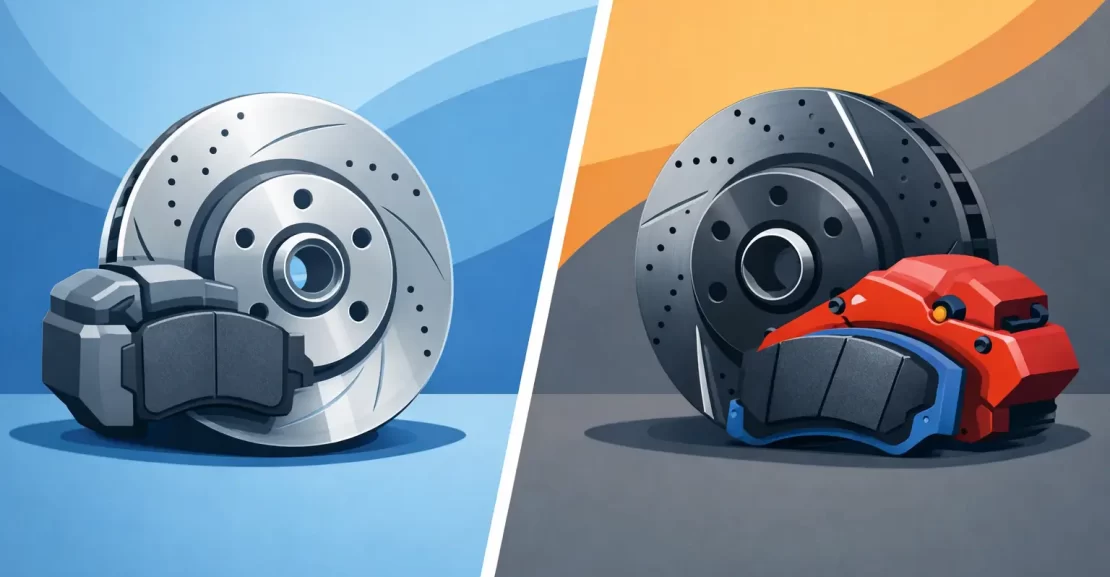
A brake pedal that has gone long, a steering wheel that shudders under braking, or a set of worn pads on a recently imported car is not the place to make a guess. OEM versus aftermarket brake parts is a decision that affects safety, pedal feel, noise, maintenance costs and how confidently you can use your car. For JDM classics, European performance cars and daily imports alike, the right answer depends on the exact vehicle and how it is driven.
The cheapest option is not always poor, and the most expensive option is not always necessary. What matters is choosing components that suit the braking system, are correctly specified, and are fitted properly.
What OEM brake parts actually mean
OEM means Original Equipment Manufacturer. In everyday workshop conversation, it usually refers to a part that matches the component originally fitted to the vehicle, whether it comes in the vehicle manufacturer’s box or from the company that supplied the factory line.
There is a useful distinction here. A genuine part is sold under the Toyota, Nissan, Honda, Mazda, Subaru, BMW or other vehicle brand. An OEM-equivalent part may be made by the original supplier and sold under that supplier’s own name. Both can be excellent choices, but they are not automatically identical in packaging, warranty terms or final specification.
For a standard road car, OEM pads and discs are designed around the factory system as a whole. They aim to provide predictable cold performance, low noise, acceptable dust levels and a reasonable service life. This balance is why OEM remains a sensible default, especially where the car is used for commuting, family duties or occasional spirited driving.
OEM can also remove uncertainty on older imports. Japanese-market models can have variations by production date, trim, axle size, transmission and factory option package. A Skyline, Supra or Honda may look straightforward until the catalogue shows several possible disc diameters or pad shapes. Correct identification matters more than a label on the box.
Where aftermarket brake parts make sense
Aftermarket does not mean one level of quality. It covers everything from well-engineered replacement components to poorly controlled budget parts. The useful question is not whether a part is aftermarket. It is whether that specific manufacturer, compound and design suit your car and intended use.
Quality aftermarket parts can offer clear advantages. A replacement pad may reduce dust, improve initial bite, tolerate higher temperatures or provide a firmer pedal feel. Slotted or two-piece discs can be useful for vehicles that see repeated hard use. Upgraded fluid, braided lines and more suitable pad compounds can make a bigger difference than fitting an oversized brake kit to a car that does not need one.
This is particularly relevant for modified cars. More power, heavier wheels, track use, Adelaide Hills runs or towing can increase brake temperatures beyond what the original pad compound was designed to handle. In those cases, a reputable performance-focused aftermarket option may be the better choice.
The trade-off is that stronger high-temperature performance can bring compromises. Performance pads may squeal when cold, create more dust, wear discs faster or require heat before they feel their best. That is acceptable on a weekend car or track-focused build. It can become frustrating on a daily-driven import that spends most of its time in traffic.
OEM versus aftermarket brake parts: key differences
The comparison is not simply factory quality against performance quality. It is a choice between priorities.
Fitment and consistency
OEM components generally offer the greatest confidence in fitment when ordered against the correct chassis and production details. This is valuable on older Japanese imports, where an incorrect hardware kit or pad backing plate can create noise, movement or poor operation.
Established aftermarket brands also have strong cataloguing and quality control, but the range is broader. A low-cost disc may technically fit while having less consistent machining, coating or metallurgy than a better-quality alternative. Brake parts are not an area to buy solely on the lowest advertised price.
Pedal feel and braking behaviour
Pads have the largest influence on how the car feels under your foot. Friction material determines initial bite, how consistently the pad works as temperatures rise, and how easily it can be modulated before ABS intervenes. OEM-style pads usually feel progressive and predictable. Road-performance pads may feel sharper, while track compounds can feel dull when cold and aggressive once hot.
Discs also matter, but usually as a supporting component. A fresh, correctly machined disc paired with the right pad will outperform an expensive disc paired with a mismatched compound. If the pedal feels soft, the cause may instead be old fluid, air in the system, worn hoses, seized caliper slides or a master-cylinder issue.
Noise, dust and everyday comfort
Brake squeal is not always a sign of a failed component. It can result from pad compound, glazing, lack of correct shims, worn hardware, disc condition or how the parts were bedded in. OEM parts are generally tuned for quiet road use, though no brake system is completely silent in every condition.
Aftermarket ceramic-style pads can reduce visible dust on some cars, while harder performance compounds can increase dust and noise. If keeping wheels clean and the cabin quiet matters more than repeated high-speed braking, say so before selecting parts. The best pad for a track day may be the wrong pad for a prestige European daily.
Cost over the full service interval
Genuine parts can cost more upfront, particularly for imported or limited-production vehicles. However, their fitment, predictable wear and reduced chance of rework can represent good value. This is especially true if the vehicle is a clean collector-grade example where original specification supports its condition and future appeal.
A quality aftermarket package can be better value when it improves longevity or suits heavier use. The savings disappear if a cheap pad damages discs, squeals constantly, fades under load or needs replacing early. Consider pads, discs, fluid, sensors, shims and labour as one brake service, not separate line items.
Match the parts to how the car is used
For a stock daily driver, OEM or premium OEM-equivalent pads and discs are usually the sensible choice. They preserve the brake balance the manufacturer intended and deliver dependable performance through normal Australian road conditions.
For a restored 1990s or 2000s Japanese classic, genuine components are worth considering where available, particularly for hard-to-source caliper hardware, sensors and model-specific parts. They help retain the vehicle’s character and avoid fitment headaches. That said, a trusted aftermarket consumable may be the practical option where genuine stock is discontinued or the car has been thoughtfully upgraded.
For a street-driven performance car, look for a road-performance pad with good cold bite and a temperature range that suits real use. Pair it with quality discs, fresh brake fluid and a full caliper inspection. More stopping power on paper is of little benefit if the car pulls to one side because a caliper is sticking.
For track days, choose parts as a system. High-temperature pads without suitable fluid can still leave you with a long pedal. Aggressive pads on tired discs can crack or judder. Extra cooling, fluid changes and more frequent inspections may be needed. Track-oriented components are consumables, not fit-and-forget upgrades.
Do not overlook the parts around the pads and discs
A brake service should include more than replacing what is visibly worn. Caliper pistons and slide pins need to move freely. Rubber boots must be intact, pad shims and retaining clips need to be correctly fitted, and disc run-out should be checked where vibration is present. Brake fluid absorbs moisture over time, reducing its boiling point and contributing to poor performance under heat.
On cars that have spent years parked, as many imported classics have, seized components and aged rubber hoses are common concerns. The braking system may look presentable through the wheel spokes while needing careful mechanical attention underneath.
Also be cautious with major brake upgrades. Changing calipers, discs or rear brake configuration can affect wheel clearance, hydraulic balance, ABS behaviour and road legality. Select components designed for the platform and get advice before committing to an upgrade package.
Make the decision with the right information
Before ordering brake parts, confirm the VIN or chassis number, build date, current caliper and disc dimensions, wheel size and how the vehicle is used. If it has been modified, include details such as engine output, wheel and tyre changes, suspension work and track use. These details prevent costly assumptions.
At Sinergy Motorsports, the focus is on supplying and fitting parts that make sense for the vehicle in front of us, whether that calls for factory-spec replacements or proven aftermarket upgrades. With brake work, the goal is straightforward: reliable stopping performance that suits the car, the driver and the kilometres ahead.