
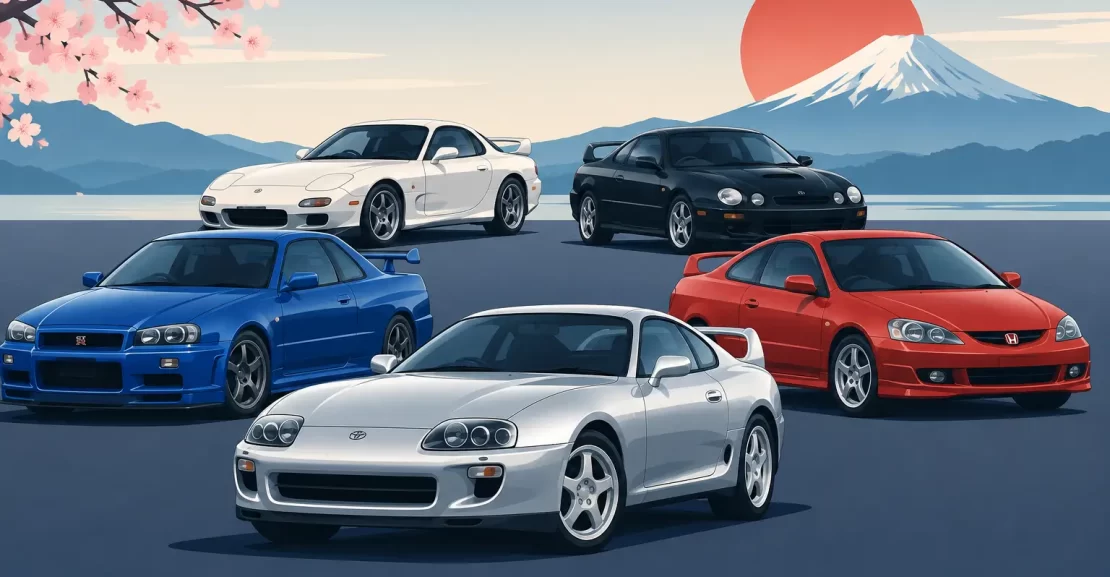
A proper Japanese coupe from the 2000s delivers something most new cars struggle to replicate: real mechanical character. The best 2000s Japanese coupes combine usable performance, distinctive styling and strong enthusiast support, but they are now old enough that condition matters far more than a badge on the bonnet.
For Australian buyers, the right car depends on whether you want a weekend weapon, a collectable JDM icon or a coupe you can genuinely use on Adelaide roads. Some are straightforward to maintain. Others reward specialist servicing and careful ownership. All deserve a thorough pre-purchase inspection before money changes hands.
What makes a great 2000s Japanese coupe?
A great coupe needs more than a big power figure. The cars worth owning have a strong drivetrain, a chassis that still feels engaging, reliable parts support and a clear history. Factory originality can add value on collectable examples, while sensible upgrades can make a driver-focused car better to live with.
Import eligibility, compliance and insurance are also part of the equation in Australia. A low-kilometre auction sheet is useful, but it is not a substitute for checking rust, previous repairs, modification quality and servicing. Turbocharged cars, rotary engines and high-revving Hondas each have their own non-negotiable maintenance requirements.
The best 2000s Japanese coupes to consider
1. Nissan Silvia S15 Spec R
The S15 Spec R remains one of the most complete JDM performance coupes of its era. Its turbocharged SR20DET, compact dimensions and rear-wheel-drive balance give it the feel buyers expect from a classic Japanese sports car. It is capable on a winding road, at a track day or as a carefully maintained weekend car.
The downside is that clean, unmodified examples are increasingly hard to find. Many S15s have lived hard lives with drift use, cheap suspension, questionable wiring or poorly fitted body kits. Look for quality cooling upgrades, clean boost control plumbing, a healthy gearbox and evidence the car has not been repaired after a heavy hit.
2. Nissan Skyline GT-R R34
The R34 GT-R is a genuine 2000s hero, even if its reputation means it is no longer a casual purchase. The RB26DETT and ATTESA all-wheel-drive system provide enormous tuning potential, while the standard car is already a serious performance machine. It has collector appeal few Japanese coupes can match.
That desirability brings risks. Provenance, chassis condition and originality carry real weight, and correct replacement parts are expensive. A GT-R should be bought on history and inspection, not on odometer reading alone. It is the right choice for a buyer prepared to protect and maintain a significant asset.
3. Mazda RX-7 FD Series 8
Few cars look as special as a late FD RX-7. The low bonnet line, light weight and twin-turbo 13B rotary make it feel unlike anything else on this list. A healthy FD is responsive, agile and properly involving without needing excessive power.
Rotary ownership requires discipline. Compression testing, cooling-system condition, oiling and tune quality are essential. A cheap RX-7 can become expensive quickly if the engine is tired or the car has been modified without proper supporting work. Buy the best documented example you can, then keep it serviced by people who understand rotaries.
4. Toyota Supra RZ JZA80
The JZA80 Supra was designed in the 1990s but remained in production into the early 2000s, and its appeal has not faded. The 2JZ-GTE is famously durable when maintained correctly, with a strong driveline and huge aftermarket support. In RZ form, it has the performance credibility to match its shape.
Prices mean buyers need to be realistic. A genuine turbo manual, matching-numbers car commands a very different figure from an automatic or converted example. Automatic cars can still be excellent to own, but an expensive manual conversion does not automatically make a car factory-correct or collectable.
5. Honda Integra Type R DC5
The DC5 Type R proves that a naturally aspirated front-wheel-drive coupe can be every bit as engaging as a turbo rear-wheel-drive car. The JDM K20A is eager, the six-speed manual is excellent and the chassis rewards precise driving. It is one of the more practical performance choices here, with useful cabin and boot space.
Check for synchro wear, tired engine mounts, neglected valve-clearance servicing and signs of track use. Avoid cars with poorly selected bolt-on modifications. A clean DC5 with quality tyres, brakes and suspension can still embarrass much newer machinery on a tight road.
6. Nissan 350Z Z33
The 350Z brought proper six-cylinder, rear-wheel-drive performance to a new generation. It is less delicate than many earlier JDM coupes and has enough torque to make everyday driving enjoyable. The wide stance, strong VQ engine note and straightforward mechanical layout have made it a long-term favourite.
Early cars can suffer from oil consumption, while hard-driven examples may show clutch, differential and suspension wear. Interior trim condition varies too. The right 350Z is a well-maintained manual with comprehensive servicing rather than the cheapest modified car advertised.
7. Nissan 370Z Z34
Introduced in 2009, the 370Z sits at the late end of the decade but deserves consideration. It is more refined and sharper than the 350Z, with stronger brakes, more power and a shorter wheelbase. For a buyer who wants a Japanese coupe to drive regularly rather than preserve, it is a compelling option.
It is also heavier and less analogue in feel than an S15 or RX-7. That may be a positive if you value modern usability, air-conditioning performance and a more substantial cabin. Check clutch operation, tyre wear, service records and any history of track use.
8. Honda NSX NA2
The facelift NA2 NSX is the rarest choice here, but it remains one of the finest Japanese coupes ever built. Its mid-mounted V6, aluminium construction and superb visibility make it special at sensible road speeds. It was engineered with exceptional care and still feels remarkably modern.
Ownership is not cheap simply because the car is a Honda. Specialist knowledge, genuine parts availability and correct servicing matter. A neglected NSX can be difficult and costly to return to standard, so this is a car where an expert inspection is essential.
9. Toyota Celica ZZT231
The seventh-generation Celica is often overlooked, which is exactly why it deserves attention. The high-revving 2ZZ-GE in the performance variant gives it real character, while the light front-wheel-drive chassis is economical to run compared with the bigger turbo legends.
It is not a Supra replacement and should not be bought as one. It is a smart choice for drivers who want a reliable, sporty Japanese coupe without taking on the running costs of an older turbo import. Listen for engine noise, check lift engagement and inspect for tired suspension bushes.
10. Toyota Soarer Z40
The Z40 Soarer, known elsewhere as the Lexus SC430, takes a different approach. It is a V8 luxury coupe with a folding hardtop, suited to relaxed touring rather than hard-charging circuit work. Its build quality, smooth drivetrain and distinctive shape appeal to buyers who want something less predictable than a German convertible.
The complex roof mechanism and ageing electronics need careful checking. A car with a roof that operates slowly, leaks or has warning lights should be assessed before purchase. When looked after properly, it is a refined and capable long-distance car.
Buying a 2000s Japanese coupe in Australia
Before choosing a model, decide what sort of ownership experience you actually want. A factory-standard DC5 or 350Z can be a relatively sensible performance car. An FD RX-7, R34 GT-R or NSX is more of a specialist commitment, where storage, parts budgets and preventative maintenance are part of the purchase decision.
Service paperwork should show more than regular oil changes. On turbo cars, look for evidence of timing-belt work where applicable, cooling maintenance, correct fluids and reputable tuning. On imported vehicles, confirm compliance details, registration status and that modifications are legal and insurable in your state.
A pre-purchase inspection by a workshop experienced with Japanese classics can reveal issues that a road test will miss: chassis rust, boost leaks, poor compression, previous accident repairs, oil leaks and worn driveline components. At Sinergy Motorsports, more than 20 years working on Japanese imports has shown that a well-kept standard car is usually a better starting point than a heavily modified bargain.
The best choice is the coupe that suits your intended use and your willingness to maintain it properly. Buy on condition, history and specialist inspection, then give it the servicing and parts support it needs to keep performing at its best.